

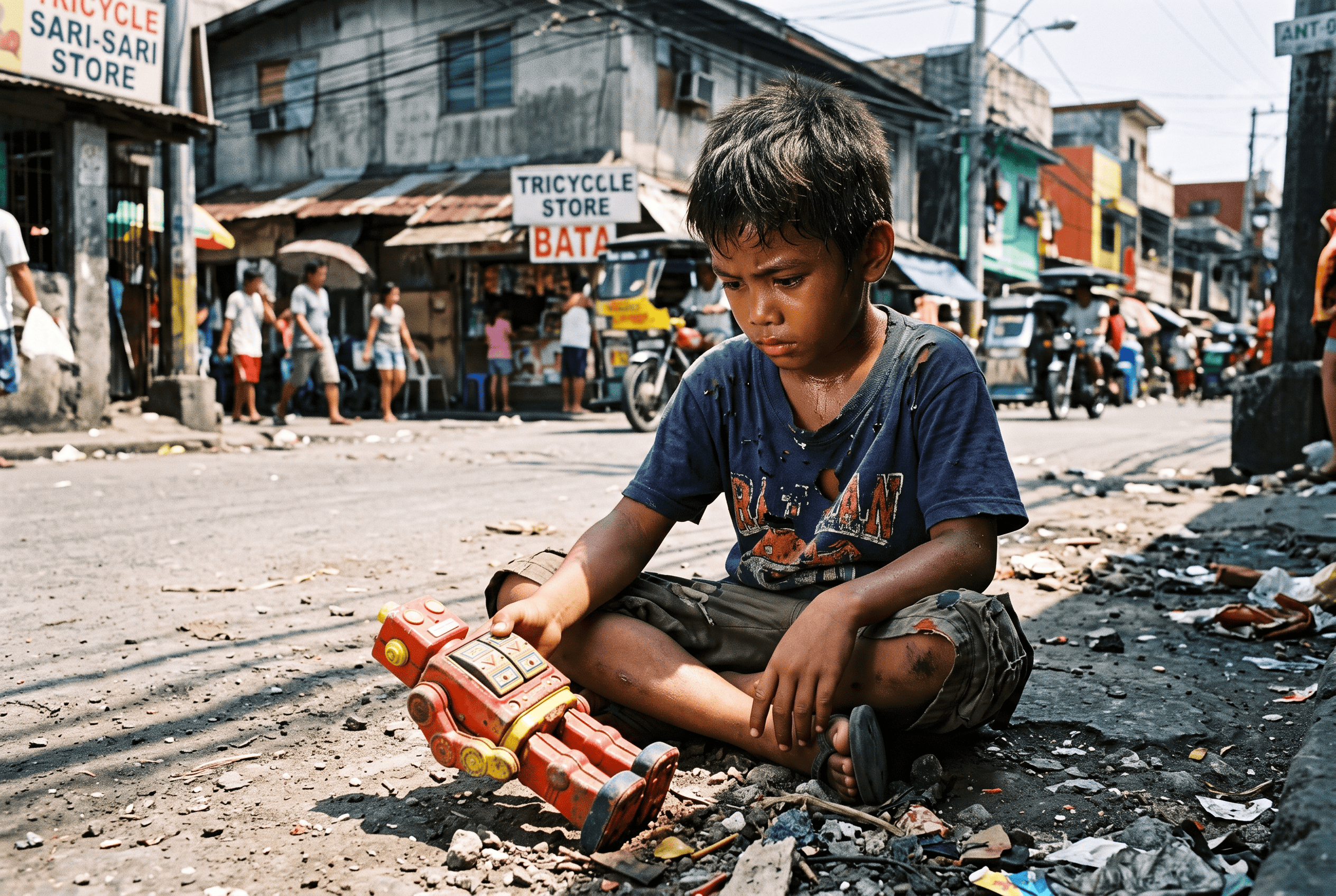
The reality of how street children in Manila live is far removed from what most people outside the Philippines ever see. These are children who sleep in doorways, scavenge for food on garbage mountains, and navigate daily dangers that no child should face. Poverty, family breakdown, and a lack of accessible support systems push thousands of Filipino children onto the streets every year. The Vision Help International Care Foundation has spent over 15 years working directly in Manila’s most vulnerable communities, providing shelter, nutrition, education, and care to children whose stories don’t have to end the way they began.
How Street Children Live in the Philippines: The Daily Reality
Life on the streets of Manila is defined by constant uncertainty. Children wake up without knowing where their next meal will come from, whether they will be safe through the night, or whether anyone will notice if something happens to them. Many sleep in groups under bridges, in markets, or in the narrow alleyways of communities like Tondo, one of the most densely populated urban areas in the world.
Most street children in Manila come from families that are still alive but simply unable to cope. Poverty in the Philippines pushes parents into impossible situations, and children often end up on the streets not because they were abandoned in a dramatic sense, but because the family’s survival structure has completely collapsed. Some children leave home voluntarily to escape abuse. Others are sent out to earn money through begging or scavenging and never find their way back.
Child poverty in the Philippines is not a background statistic in these communities. It is the air people breathe. In areas like Smokey Mountain in Tondo, families build their lives on and around a massive garbage dump, sorting through waste to find materials they can sell for a few pesos. Children grow up doing the same work alongside their parents from a very early age.
What Happens to Street Children Without Support?
Without intervention, the trajectory for most street children in Manila is grim. Exposure to child labor is almost inevitable, with children working in dangerous conditions to contribute to household income or simply to survive on their own. Vulnerability to trafficking and sexual exploitation increases significantly the longer a child remains on the streets without a stable adult presence in their life. The Vision Help International Care Foundation addresses this through community-based outreach and residential care programs that reach children before the window for meaningful intervention closes.
Life in the Slums of Manila: Understanding the Broader Context
Street children don’t exist in isolation from their communities. Life in the slums of Manila shapes everything about how these children grow up, what they believe is possible for them, and what kind of support they can realistically access. In communities like Balut in Tondo, where VHICF operates its Mercy Ministry, entire neighborhoods are built on flood-prone land with no reliable sanitation, electricity, or clean water.
The Connection Between Family Poverty and Children on the Streets
Most families in these communities are not neglectful by choice. Parents work exhausting hours in informal labor markets for wages that don’t cover rent, food, and school fees simultaneously. When something goes wrong—illness, job loss, or a natural disaster—children are often the first to bear the consequences. Effects of poverty on children in these environments include malnutrition, interrupted schooling, early exposure to violence, and a profound lack of the stability that healthy development requires.
Understanding this context matters because it shapes what effective intervention looks like. Removing a child from the street without addressing the family’s underlying situation rarely produces lasting results. The most sustainable programs combine direct child support with family assistance, parental education, and access to livelihood resources.
How Nutrition Programs Help Children in the Philippines Thrive
Two of the most powerful interventions for street children are also among the most straightforward: food and schooling. Nutrition programs that help children in the Philippines do far more than address physical health. Children who are adequately nourished attend school more consistently, concentrate better in class, and develop stronger emotional resilience. In communities where malnutrition is common among children under five, a structured feeding program can change a child’s developmental trajectory within months.
Education works in a similar way. Education for children in the Philippines is not free at all levels, which means many families in poverty simply cannot afford to keep their children in school. Sponsorship programs and educational support initiatives that cover school fees, supplies, and transportation remove barriers that would otherwise keep children out of classrooms and on the streets.
Help for Children in the Philippines: What Actually Works
Decades of work by nonprofits, government agencies, and international organizations in Manila have produced some clear lessons about what genuinely helps street children and what doesn’t. Effective programs share several characteristics:
- They are community-based, meaning staff are present in the neighborhoods they serve rather than operating from a distance
- They address the whole child, including physical health, emotional well-being, education, and family relationships
- They offer continuity, with children and families able to access support over months and years rather than through one-off interventions
- They maintain accountability to the communities they serve, adjusting programs based on actual needs rather than assumptions
Help for street children that is parachuted in without community roots tends to produce short-term results at best. The organizations that create lasting change are those that embed themselves in a community and stay.
What Changes a Child’s Story
No single program or organization can solve the problem of street children in Manila alone. But the evidence from sustained, community-based work is clear: stable care, consistent education, reliable nutrition, and the presence of trusted adults genuinely change outcomes for children who would otherwise have very few options.
Donations for children directed toward organizations working on the ground in Manila fund exactly these kinds of programs. Every feeding cycle completed, every child enrolled in school, and every abandoned infant given a safe home represents a story that took a different direction because someone chose to help. The Vision Help International Care Foundation has been creating those moments of change for over 15 years in communities where children in need are not a cause but a daily reality that the organization’s staff and volunteers live alongside every single day.